
【Taiwan Startup Investment Trends Annual Report – Health Care】Amid the AI Wave, Capital Restructures as the Sector Awaits a Rebound
Taiwan’s healthcare startup sector has a strong foundation in clinical R&D, medical databases, and ICT, offering opportunities for innovation and growth. The global rebound in healthcare investment in 2025, led by digital health and AI, highlights the potential of these strengths. While Taiwan’s healthcare investment declined in 2025, capital increasingly focused on more mature startups with demonstrated clinical results and proven performance. Digital health stood out, attracting record investment driven by generative AI and telehealth. Corporate venture capital, emerging funds, and continued government support for R&D and innovation provide a foundation for further development. By translating technological strengths into clinical and commercial outcomes, expanding international connections, and building robust business models, Taiwan’s healthcare startups can strengthen their investment appeal and position themselves for sustainable growth.
With strengths in clinical R&D, medical databases, and ICT, Taiwan is well positioned to develop its healthcare industry, a key focus of the government's Healthy Taiwan initiative and efforts to cultivate the country's next trillion-dollar industry. However, fundraising has become increasingly challenging for biomedical startups in recent years. Beyond the industry's long development cycles, high risks, and substantial capital requirements, startups also face growing competition for investment from AI hardware and software, as well as global geopolitical and economic uncertainty. Nevertheless, the growth of digital health, the emergence of new investment funds, and continued policy support are gradually creating conditions for a recovery in Taiwan's healthcare startup sector.
Global Investment Recovers with Healthcare AI in Focus
After reaching a peak in 2021, the global healthcare investment market underwent a period of correction before returning to growth in 2025. That year, the market recorded 2,353 investment deals totaling US$60.4 billion, representing year-over-year increases of 2.71% in deal count and 3.96% in investment value. Growth continued into the first half of 2026, with investment value reaching US$32 billion, up 16.36% year over year.
In 2025, investment value in digital health rose 77%, while medical devices recorded a 27% increase. Healthcare AI emerged as a major investment focus, attracting nearly US$18 billion in venture capital across Europe and the U.S., equivalent to 46% of healthcare investment in those markets. Key applications included AI-driven drug development and clinical workflow automation.
Taiwan's Investment Sees a Short-Term Decline; Capital Shifts Toward Mature Startups
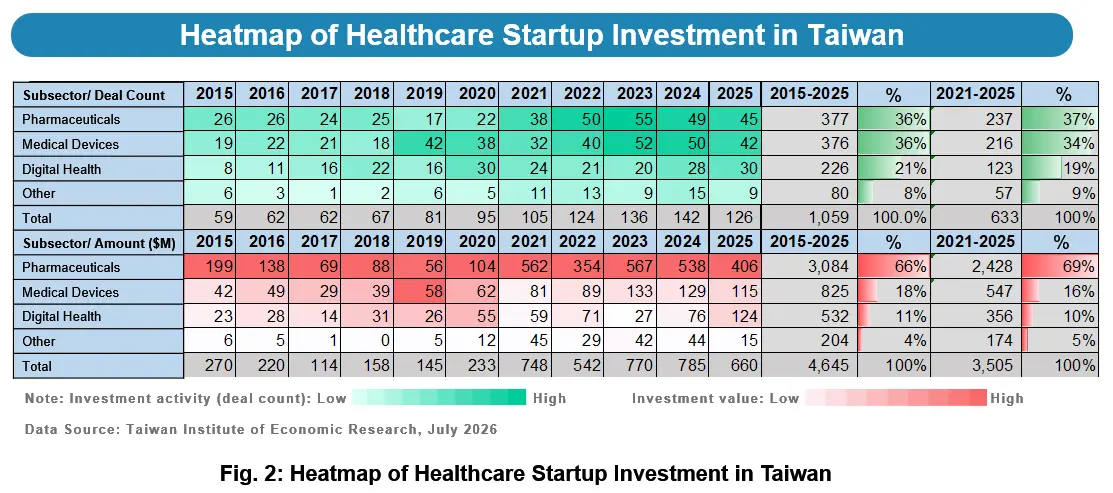
Between 2015 and 2025, Taiwan's healthcare startups recorded 1,059 investment deals totaling US$4.645 billion, accounting for approximately 20% of both total startup deal count and investment value. In 2025, the sector recorded 126 deals totaling US$660 million, representing year-over-year declines of 11% and 16%, respectively, and a weaker performance than the global market. However, excluding AltruBio's US$225 million funding round in 2024, investment value in 2025 would have increased by 18%. This suggests that the market was not in an overall decline, although deal activity did weaken.
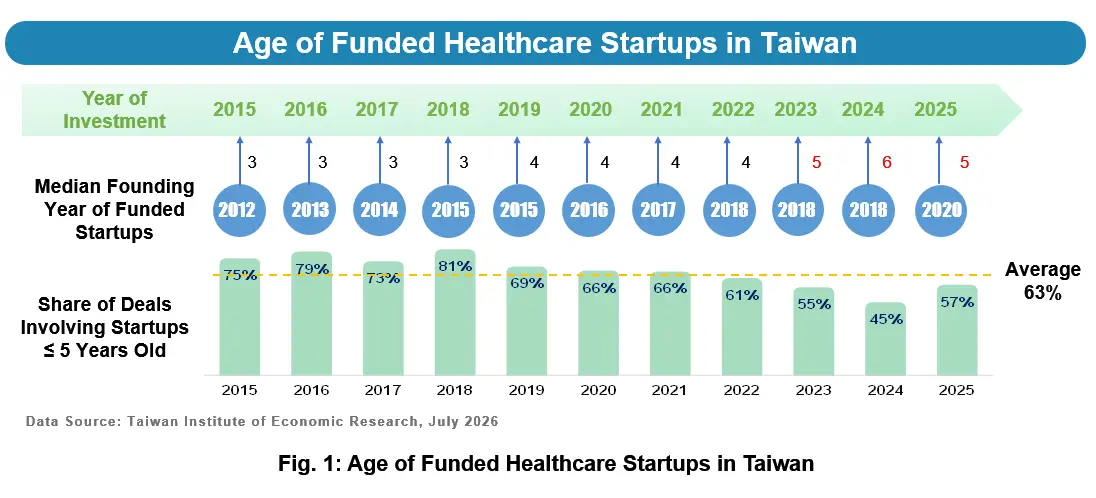
Investment has gradually shifted toward startups with demonstrated clinical results and proven operating performance. The median age of funded startups rose from three years in 2015-2018 to five to six years in 2023-2025, reflecting investors' growing emphasis on validation data and risk management. Between 2015 and 2025, Series A and earlier rounds accounted for 77% of healthcare startup investment deals, while mid- and late-stage rounds represented 16%, compared with 12% for the overall startup market. In 2025, the number of deals valued at US$10 million or more reached 22, the second-highest level on record. The median deal size also reached a record high of US$2.55 million, indicating that capital continued to concentrate in startups with strong growth potential.
 Healthcare Subsectors Show Diverging Investment Patterns; Digital Health Bucks the Trend
Investment trends varied across healthcare subsectors. Between 2015 and 2025, pharmaceuticals and medical devices recorded 377 and 376 investment deals, respectively. Pharmaceuticals accounted for approximately 69% of total investment value, reflecting the subsector's substantial R&D funding requirements.
In 2025, both deal count and investment value declined in these two subsectors. Digital health, however, bucked the trend, recording 30 deals totaling US$124 million, with investment value reaching a record high. Growth was driven by generative AI, telehealth, medical device software, and demand for health management solutions. Digital health services also expanded beyond standalone testing tools to encompass screening, diagnosis, care, and integration of hospital operations.
Pharmaceutical investment focused on regenerative medicine, cell and gene therapies, antibody-drug conjugates (ADCs), nucleic acid therapeutics, and contract development and manufacturing organization (CDMO) services. In 2025, Taiwan Bio-Manufacturing Corporation (TBMC) completed a US$69.8 million Series A round to expand its manufacturing facilities and strengthen its R&D capabilities.
Meanwhile, investment in medical devices shifted toward higher-value solutions and cross-disciplinary integration, with areas of focus including precision reproductive testing, minimally invasive treatments, spatial proteomics, and microneedle drug delivery. Notable digital health startups include Nitra, which completed a US$22 million Series A round, and H2 Inc., which completed a US$20 million Series C round. The two companies focus on healthcare operations automation and chronic disease management, respectively.
Corporate and Policy Support Bolster the Sector; New Biomedical Funds Emerge
Between 2015 and 2025, C/CVC participated in 58% of healthcare startup investment deals, followed by VC at 37%, the National Development Fund (NDF) at 16%, and foreign investors at 8%. These percentages are not mutually exclusive, as multiple investor types may participate in the same deal. In 2024-2025, C/CVC participation rose to 61%, while NDF participation increased to 18%, reflecting investment from ICT companies across sectors and continued policy-driven funding. However, the relatively low participation of foreign investors highlights the need to strengthen international investment linkages.
Capital availability and policy support will be critical going forward. In 2026, CDIB Capital's Healthcare Fund III, Daiwa Taiwan-Japan Biotech Fund III, and Affinity Healthcare Fund III were either launched or in the planning stages, with a combined fundraising target of approximately NT$12 billion. The actual amount invested will depend on fundraising and investment progress. The government is also supporting R&D, clinical validation, and commercial applications through the Act for the Development of Biotech and Pharmaceutical Industry, the two regenerative medicine laws, the Healthy Taiwan Cultivation Plan, age tech initiatives, and the National Drug Resilience Program. The NDF has also earmarked NT$10 billion to promote smart healthcare innovation and entrepreneurship.
Driving Recovery and Transformation Through Proven Results and International Linkages
The key to future recovery lies in translating technological strengths into clinical and commercial outcomes. The government should strengthen international investment linkages, clinical procurement systems, and mechanisms for M&A and public listings to facilitate capital circulation. Meanwhile, startups need to improve their fundraising prospects by demonstrating clinical results, providing real-world data, and establishing a proven revenue track record. They should also leverage corporate distribution channels and healthcare resources while planning ahead for overseas patent protection, regulatory requirements, and customer development. With patient capital, cross-sector collaboration, and international expansion, Taiwan's healthcare industry can gradually move toward recovery and transformation.