
【Taiwan Startup Investment Trends Annual Report – Media & Entertainment 】From Global AI Wave to Local IP Partnerships: A Decade of Resilient Growth in Taiwan
Taiwan's media and entertainment startup sector, despite facing challenges like smaller deal sizes and a slowdown in 2025 due to AI/semiconductor investment concentration and market constraints, shows resilience. Global trends like the rise of the experience economy, seamless engagement, and AI adoption in content creation are influencing the landscape. Taiwan's startups are focusing on MarTech, leveraging government support for international IP expansion in content production, and developing immersive venue equipment. The future lies in moving beyond small-scale production, utilizing AI, and forming strategic partnerships to enhance global competitiveness.
1. Four Key Trends in the Global Media & Entertainment Industry
The media & entertainment industry is undergoing a structural transformation driven by the widespread adoption of generative AI, shifts in the streaming landscape, and evolving consumer behavior. According to PwC's Global Entertainment & Media Outlook 2026–2030, global E&M revenue reached US$3.5 trillion in 2025 and is projected to grow at a compound annual growth rate (CAGR) of 3.4% to US$4.2 trillion by 2030. Four major trends stand out:
- Rise of the Experience Economy: As screen-based content becomes increasingly pervasive, demand for authentic, shared, and immersive experiences is growing. Revenue from large-scale immersive venues, theme parks, and live performances has reached record highs.
- Seamless Engagement: Subscription fatigue is driving streaming platforms to adopt AI-powered personalized recommendations and develop viewing experiences that integrate interactive TV and on-demand shopping, allowing consumers to shop and interact with content while watching.
- AI Adoption Increases the Value of Human-Created Content: As AI lowers barriers to content production, growing concerns over low-quality content are driving demand for intellectual property technologies (IPTech), including content authentication, blockchain, and copyright provenance verification.
- Hollywood Embraces AI: Film studios are integrating AI into core production processes through acquisitions and investments in technology startups, while emphasizing that creators retain ultimate creative control.
2. Investment Trends in Taiwan's Media & Entertainment Startups (2015-2025)
The FINDIT Research Team at the Taiwan Institute of Economic Research has long tracked investment activity among pre-IPO startups registered in Taiwan or founded by Taiwanese entrepreneurs.
2.1 Investment Overview (2015-2025): Small Deals and Very Early-Stage Funding
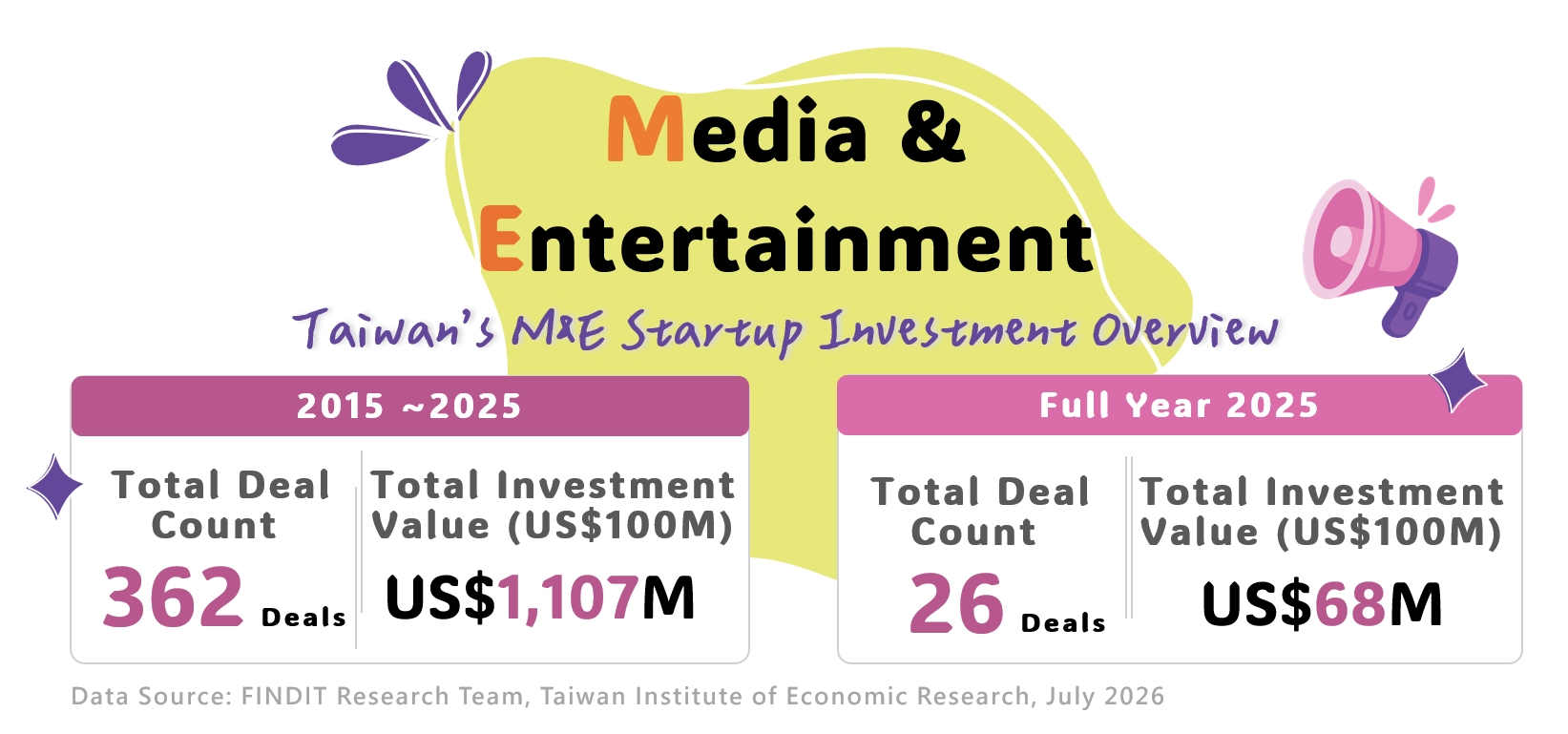
Between 2015 and 2025, Taiwan's media & entertainment startups recorded 362 investment deals, accounting for approximately 7.1% of all startup investment deals in Taiwan. Disclosed investment value totaled US$1.107 billion (approximately NT$35.708 billion), representing 5.1% of the country's total startup investment value.
Investment activity was dominated by smaller deals, with 59.1% valued at under US$2 million and 76.8% below US$5 million. Across Taiwan's overall startup market, deals exceeding US$5 million accounted for more than 20% of total deal count, while those valued at US$10 million or more represented 10.2%. In contrast, only 11.9% of media & entertainment deals exceeded US$5 million, roughly half the share recorded across the broader startup market.
By funding stage, investment was heavily concentrated in Series A and earlier rounds, which accounted for 79.3% of total deal count. Very early-stage rounds, including angel, seed, and Pre-A rounds, represented 48.6%, while Series A rounds accounted for 30.7%. Mid- to late-stage rounds, including Series B, C, and D, collectively represented just 12.7%. These figures suggest that domestic investors remain willing to support early-stage creative teams, but larger investments in later-stage startups remain relatively limited due to Taiwan's small domestic market and the challenges in scaling internationally.
2.2 Trends in 2025: Investment Activity Slows
In 2025, investment activity in Taiwan's media & entertainment sector fell to one of its lowest levels in recent years, with just 26 deals (4.7% of Taiwan's total startup deal count) and US$68 million in disclosed investment value (2.5% of the total). Three key factors contributed to this slowdown:
- Competition for Funding: Venture capital in both global and Taiwanese markets has become increasingly concentrated in AI computing infrastructure and semiconductors, leading investors to scrutinize the valuations of entertainment-related startups more closely.
- Market Size and Monetization Constraints: Taiwan's relatively small domestic market limits growth opportunities, while projects relying solely on domestic demand often struggle to deliver the rapid growth and exit potential expected by venture capital investors.
- Increased Investor Risk Aversion: Amid broader economic uncertainty, investors are placing greater emphasis on cash flow and stable revenue generation, reducing their willingness to invest in original content that has yet to demonstrate market viability.
3. Subsector Analysis and Future Opportunities
Taiwan's media & entertainment sector can be divided into seven subsectors: (1) advertising, marketing, and talent management, (2) social networking, dating, and livestreaming, (3) content production and IP development, (4) venue equipment and software services, (5) gaming and esports, (6) media and e-books, and (7) OTT streaming platforms. Despite the challenging investment environment, several subsectors continue to show resilience and strategic potential:
- Advertising, Marketing, and Talent Management Technologies (MarTech): By integrating generative AI tools and data analytics, startups help businesses improve conversion rates and match brands with suitable influencers. Their stable B2B business models continue to attract investor interest.
- Content Production and International IP Expansion: To overcome the limitations of small-scale production, the government is promoting tax incentives, cross-sector co-investment through the National Development Fund (NDF), and international joint ventures and co-productions supported by institutions such as the Taiwan Creative Content Agency (TAICCA). These initiatives aim to attract larger private investments, share investment risks, and help Taiwanese film, television, animation, and comics IP reach international markets.
- Venue Equipment and Software Solutions: Capitalizing on the global rise of the experience economy, Taiwanese startups are combining their hardware manufacturing strengths with AR/VR and interactive exhibition technologies to develop immersive venues and interactive equipment, creating new opportunities in the global experiential entertainment market.
4. Conclusion
As the global media & entertainment industry shifts toward offline experiences and cross-sector IP monetization, Taiwan's media & entertainment startups continue to demonstrate resilience and creative potential. Looking ahead, these startups could drive cross-sector development and enhance international competitiveness by moving beyond fragmented, small-scale production models and leveraging government-supported co-investment mechanisms, generative AI-assisted production processes, and strategic partnerships.