【Taiwan Startup Investment Trends Annual Report – Defense & Military】Trusted Supply Chains Fuel Investment, Smart Unmanned Systems Fortify Defenses
Taiwan's defense and military sector is experiencing a significant investment surge, driven by geopolitical shifts, particularly the Russia-Ukraine war and Indo-Pacific tensions. Historically a closed industry, Taiwan is now opening up to private tech startups, fostering innovation in areas like AI, autonomous systems, and LEO satellites. Between 2015-2025, the sector saw 155 deals totaling $444 million, with a notable increase in investment value post-2022. Early-stage investments dominate, with unmanned vehicles leading in deal count and defense aerospace in average investment value. Startups are advised to adopt dual-use strategies, focusing on high-barrier technologies like GPS-independent navigation and AI edge computing, to leverage commercial applications and contribute to national security and allied supply chains. Taiwan is positioning itself as a strategic security hub, building on its semiconductor and ICT strengths.
1. Introduction
In recent years, major geopolitical shifts have reshaped the global defense technology sector. Once dominated by restrictive government procurement practices and lengthy R&D cycles, the sector has become a major focus for investment, with growing interest in artificial intelligence, autonomous systems, unmanned vehicles, and low Earth orbit (LEO) satellites. The Russia-Ukraine war and rising security risks in the Indo-Pacific have demonstrated the tactical value of low-cost, highly mobile asymmetric warfare equipment and dual-use technologies, helping drive global investment in the sector to record levels.
Amid U.S.-China strategic competition and the global shift toward non-PRC supply chains, Taiwan occupies a strategically important position within the First Island Chain. Through its indigenous military aircraft and shipbuilding programs, along with substantial increases in defense spending, Taiwan is opening its traditionally closed defense industry to greater participation by private technology startups. This is creating new opportunities for startups to contribute to national defense while driving innovation across precision manufacturing and ICT industries. Defense technology is thus becoming an increasingly important driver of both national security and industrial innovation.
2. Investment Overview of Taiwan's Defense & Military Sector
2.1 Deal Count and Investment Value
According to investment data compiled by the FINDIT Research Team, Taiwan's defense & military sector recorded 155 investment deals between 2015 and 2025, accounting for approximately 3.05% of all startup investment deals in Taiwan during the period. Disclosed investment value totaled approximately US$444 million, representing 2.05% of the country's total startup investment value.
2.2 Historical Investment Trends
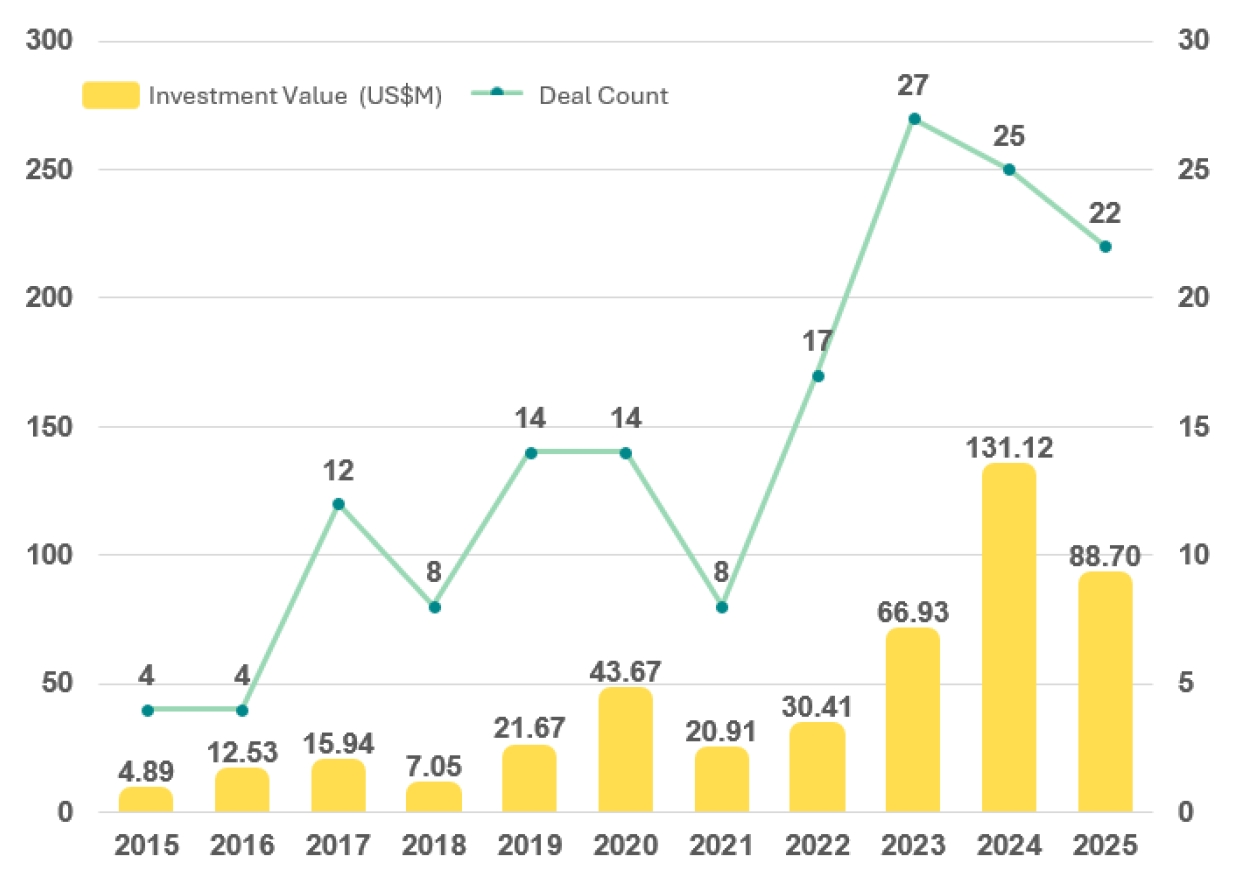
Before 2021, investment in Taiwan's defense & military sector remained relatively limited, with annual deal counts generally at or below 13 and annual investment value never exceeding US$50 million. The outbreak of the Russia-Ukraine war in 2022 marked a turning point, prompting a restructuring of global security-related supply chains. Together with the global shift toward non-PRC supply chains and the Taiwanese government's promotion of the Five Trusted Industry Sectors, these developments contributed to a significant surge in investment activity.
Deal count reached a record high of 27 in 2023 before declining slightly to 25 in 2024 and 22 in 2025. Investment value, however, rose sharply to a record US$131 million in 2024 and remained elevated at US$88.7 million in 2025. This suggests a shift from smaller, exploratory investments toward larger funding commitments.
 Note: The data covers the period from January 1, 2015 to December 31, 2025.
Data Source: FINDIT Research Team, Taiwan Institute of Economic Research
Fig. 1: Taiwan's Defense & Military Investment – Annual Deal Count and Investment Value
2.3 Early-Stage Investments Dominate Deal Count and Value; Over 60% of Deals Under US$2M
Early-stage deals dominate Taiwan's defense & military sector, accounting for 80.65% of total deal count and 64.68% of investment value. Mid-stage deals represent 12.90% and 22.80%, respectively, while late-stage deals account for just 0.65% and 6.96%, reflecting a cautious approach to late-stage investment.
By deal size, investment activity in Taiwan's defense & military sector between 2015 and 2025 was dominated by smaller deals. Of the 155 deals recorded, 94 (60.65%) were valued at under US$2 million, including 52 under US$1 million. This indicates that smaller investments remain the norm. Although some deals ranged from US$2 million to US$10 million and a handful exceeded US$10 million, larger deals remained relatively rare.
2.4 Defense Aerospace Leads in Average Investment Value; Unmanned Vehicles Lead in Deal Count
The analysis covers three subsectors: defense aerospace, defense applications, and unmanned vehicles. Supported by government policies promoting the use of commercial technologies for military applications and growing demand for asymmetric warfare capabilities amid geopolitical tensions, the unmanned vehicles subsector has emerged as the most active, recording 66 deals with an average investment value of US$2.36 million.
Defense aerospace recorded 54 deals, with an average investment value of US$4.11 million, ranking highest among the three subsectors in both average and total investment value. Defense applications accounted for 35 deals, averaging US$1.89 million per deal. Overall, unmanned vehicles lead in deal count, while defense aerospace ranks highest in investment value. Defense applications, meanwhile, derive their value from core technologies.
3. Conclusion
Taiwan's defense industry has evolved from a traditionally closed system into a more flexible ecosystem involving private startups and strategic investors. For startups, success will depend on adopting a dual-use strategy and focusing on advanced hardware and software technologies with high barriers to entry, such as GPS-independent autonomous navigation, AI edge computing, and high-frequency anti-jamming chips. This approach would allow startups to serve commercial markets in peacetime while rapidly adapting their technologies for tactical applications in wartime. They can also leverage technologies validated in Taiwan's defense sector to gain a foothold in the supply chains of allied countries.
Looking ahead, Taiwan's defense & military sector is expected to increasingly emphasize unmanned systems, low-cost scalability, and software-driven capabilities. Unmanned vehicles will play a leading role in integrating defense capabilities across land, sea, and air, while LEO satellites and next-generation communications will move toward greater system integration. Cybersecurity and AI will also become essential to software-defined defense. Building on its strong semiconductor and ICT foundations, Taiwan is evolving from a major technology manufacturing hub into an indispensable strategic security hub within the non-PRC supply chains of democratic countries.