【Taiwan Startup Investment Trends Annual Report – Investors】Advancing with Caution: More Selective Investment, from Breadth to Depth
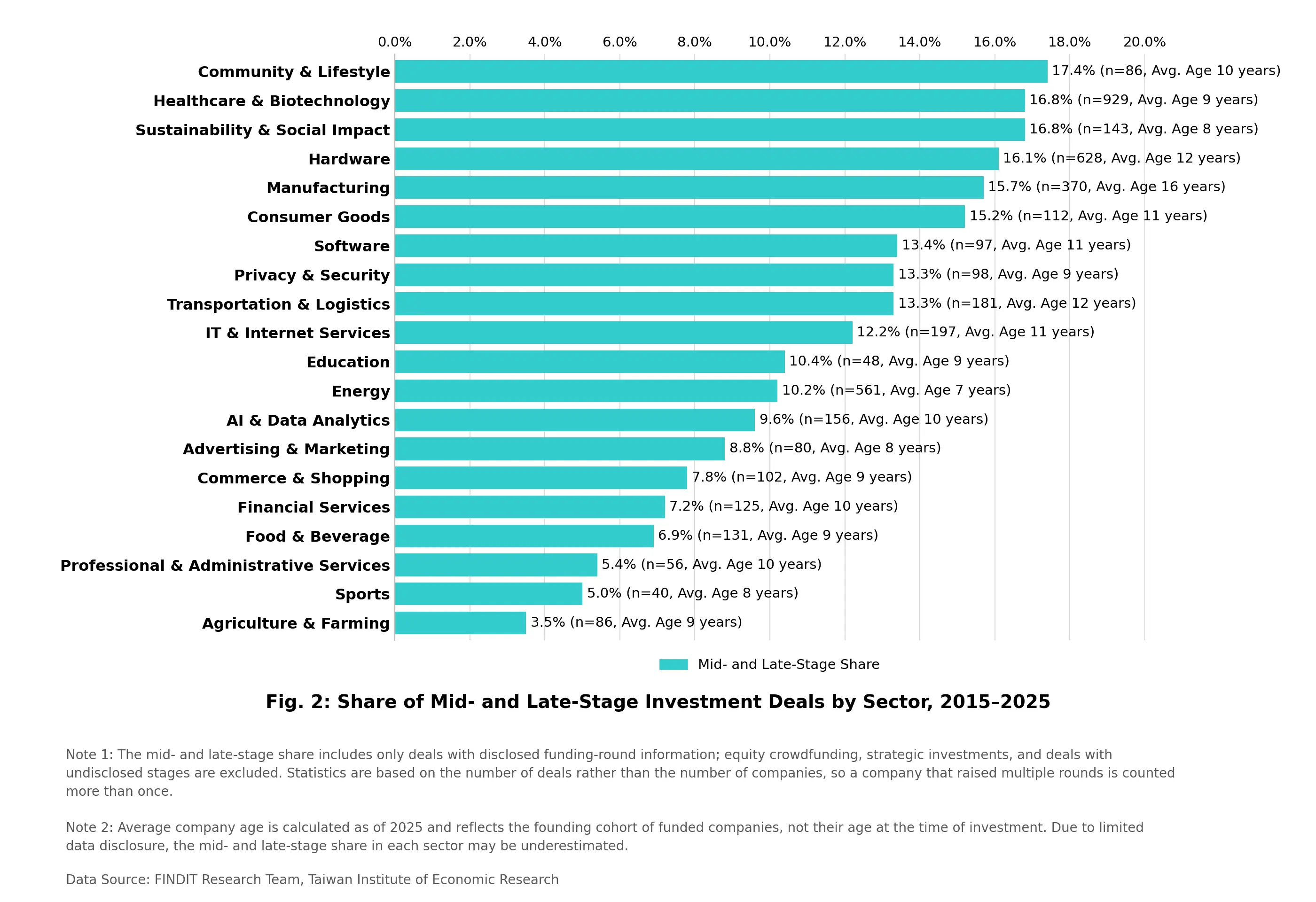
Taiwan’s startup investment slowed in 2025, but followed a different pattern from the global market, where record funding coincided with a five-year low in deal count. In Taiwan, deal counts fell while investment values remained well above pre-pandemic levels, with capital shifting toward fewer, larger deals. Angel investors and VCs both saw average deal sizes rise, and the share of seed and angel rounds in angel deals fell from 75% to 62%. C/CVCs, the largest source of startup funding, recorded declines of about 20% in both deal count and value, and their early-stage share dropped to 59%, contrary to the global CVC trend. Among active corporate investors, energy rose to 47.2% of deals, increasingly led by energy companies extending along their own value chains, while corporate investment in AI has yet to grow. Progression to growth-stage funding also varies widely by sector: healthcare & biotechnology, hardware, and manufacturing exceed 15%, while energy stands at only 10.2%, likely because energy projects rely more on project financing than on equity rounds.
Global venture capital investment in 2025 was marked by a sharp divergence between investment value and deal count. According to CB Insights, total investment reached US$469.3 billion, up 46.8% year over year, while deal count fell to a five-year low of 29,501. This divergence reflects a growing concentration of capital in a small number of large deals, particularly in AI.
Taiwan also experienced a slowdown in investment activity, but followed a different pattern. Although deal counts for angel investors, VC, and C/CVC declined from their peaks, investment values remained well above pre-pandemic levels, with capital similarly concentrated in large deals. Overall, Taiwan's startup investment landscape is shifting toward fewer, more focused investments, with investors becoming increasingly selective in their decisions.
1. Fewer but Larger Deals: Three Investor Groups Turn More Cautious
Both angel investors and VC recorded relatively stable deal counts alongside increases in average deal size. Among angel investors, average deal size rose steadily from US$3.48 million in 2023 to US$4.04 million in 2025, while the share of seed and angel rounds declined from 75% to 62%, indicating greater caution toward newly established startups. Following its 2021 peak, VC activity did not return to pre-pandemic levels but instead entered a period of higher investment activity and lower volatility. The share of large deals exceeding US$10 million more than doubled from 9.4% in 2015-2020 to 20.0% in 2021-2025.
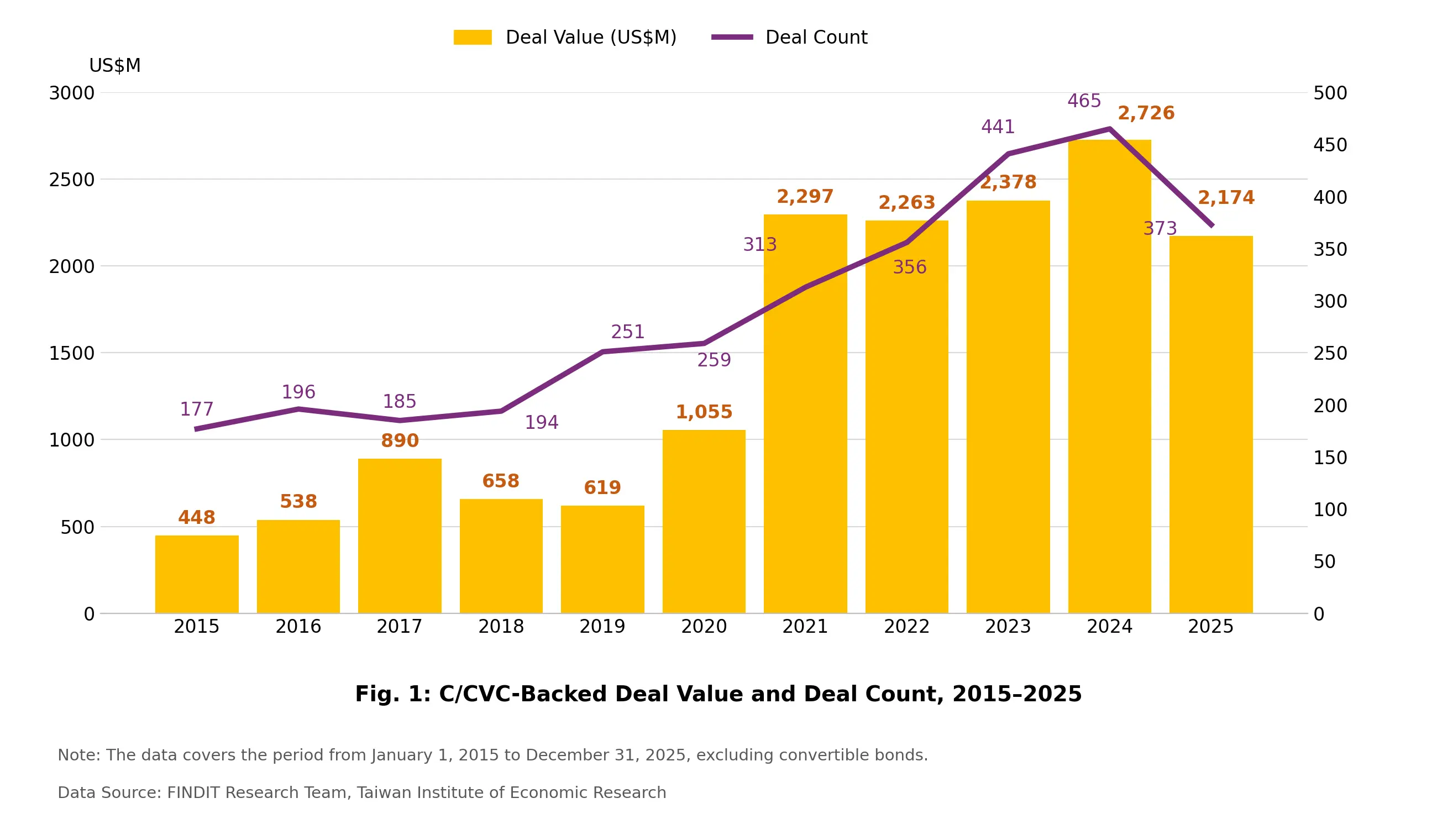
C/CVC represents the largest source of startup funding in Taiwan and experienced the most pronounced slowdown in 2025. As shown in Fig. 1, C/CVC investment grew severalfold between 2021 and 2024 compared with pre-pandemic levels, before declining significantly for the first time in 2025. Deal count fell from 465 to 373, while investment value dropped from US$2.726 billion to US$2.174 billion, both down approximately 20%. Nevertheless, large deals exceeding US$10 million still accounted for more than 60% of total investment value that year.
Meanwhile, the share of investments in rounds before Series A fell from its previous range of 74%-82% to 59%. This contrasts with the global CVC trend toward greater early-stage participation, suggesting that Taiwanese corporations have become more cautious about investing in high-risk early-stage startups amid the market slowdown.
2. C/CVCs Prioritize Energy Investment and Act More Like Value Chain Integrators
Among corporate investors with at least seven investment deals, the share of deals in the energy sector rose from 33% in 2020-2022 to 47.2% in 2023-2025, while the number investing in energy increased from 12 to 17. The profile of major investors also shifted. Earlier investments were largely driven by conglomerates, including financial holding companies, whose investments were primarily motivated by financial returns. In recent years, however, energy companies such as HD Renewable Energy and J&V Energy have taken the lead, expanding their investments beyond power generation into energy services and the circular economy.
In hardware and manufacturing, investors are predominantly semiconductor and electronics companies, which tend to invest in startups along their own supply chains, reflecting a strong strategic focus. Notably, despite the rapid rise of generative AI, the number of deals involving C/CVCs in AI & data analytics has not increased accordingly.
3. Progression to Growth-Stage Funding Varies Widely Across Sectors
Beyond investment allocation across sectors, startups' ability to secure follow-on funding after their initial rounds is critical to the health of the ecosystem. Fig. 2 examines the share of mid- and late-stage deals across sectors. Sectors such as healthcare & biotechnology, hardware, and manufacturing, which typically involve lengthy product development cycles and require funding at multiple stages, recorded shares exceeding 15%. Energy, despite ranking third in deal count, had a share of just 10.2%.
The analysis also found that neither company age nor funding sources alone explains these differences. Sustainability, another net-zero-related sector with a relatively high proportion of startups, recorded a mid- and late-stage deal share of 16.8%. Hardware and manufacturing, which have substantial CVC participation, also recorded a relatively high share. A more likely explanation is that energy companies are often established for individual projects, with subsequent funding typically secured through project financing rather than equity rounds. Meanwhile, the lower shares in service-oriented sectors such as food & beverage and commerce & shopping may reflect their greater reliance on operating cash flow to support growth, rather than a lack of access to funding.
4. Conclusion
Investment in healthcare & biotechnology is relatively evenly distributed between younger and more established startups, with funding extending into the growth stage. The sector also leads in both the number of funded startups and deal count, making it a key focus for Taiwan's investors.
Looking ahead, three developments will be worth watching: the increasing concentration of angel and VC funding in more mature startups, which could make early-stage fundraising more challenging; the potential expansion of corporate investment in AI beyond hardware into software and applications, given that AI already ranks among the top four sectors for angel and VC investment; and the prospects for a recovery in energy investment amid regulatory and land-use constraints. Ultimately, stronger continuity between early-stage and growth-stage funding will be essential to building lasting resilience in Taiwan's startup ecosystem.