【Taiwan Startup Investment Trends Annual Report – Sustainability & Green Energy】As Investment Boom Fades, Taiwan’s Green Startups Retain Advantages for Growth
Global sustainability and green energy sectors are experiencing a shift, moving beyond policy advocacy to become core drivers of industry competitiveness and capital allocation. While global climate tech investment saw a surge in 2021-2022 followed by an adjustment in 2023, long-term demand for net-zero emissions and energy transition remains strong, evidenced by a growing number of unicorns and M&A deals. Taiwan's sustainability startups attracted approximately US$790 million across 252 deals from 2015-2025, with a focus on environmental dimensions like waste recycling and eco-friendly materials. The green energy sector in Taiwan secured US$5.59 billion over 599 deals, dominated by solar and energy storage. Despite a slowdown in 2025 due to market adjustments and policy uncertainties, both sectors show continued growth potential, with investors increasingly prioritizing technological maturity, scalable business models, and measurable impact.
As global efforts toward net-zero emissions accelerate and demand for corporate sustainability and supply chain decarbonization continues to grow, sustainability is becoming a key factor shaping industry competitiveness, capital allocation, and business models, moving beyond its traditional focus on policy advocacy and corporate responsibility.
Meanwhile, the growing adoption of AI, data analytics, and digital technologies in energy management, carbon accounting, and resource circulation is making climate tech an increasingly important investment area in the global venture capital market. The green energy industry is also gradually forming a comprehensive energy value chain, expanding beyond renewable energy sources such as solar, wind, geothermal, hydrogen, and bioenergy to include energy storage, smart grids, virtual power plants, electricity trading, and related equipment and materials.
Global Trends in Sustainability & Green Energy
Global climate tech investment surged in 2021-2022 but entered a period of adjustment in 2023 amid inflation, interest rate hikes, and growing caution among venture capital investors. Although investment has declined from its peak, total investment value in 2025 remained above levels seen during the sector's early development, indicating that long-term demand for net-zero emissions, energy transition, and energy security continues to support market growth.
As of July 2026, there were 302 climate tech unicorns worldwide, including 24 valued at more than US$10 billion. Since 2019, the sector has also recorded 1,192 tracked mergers and acquisitions (M&A) deals, with a total disclosed deal value of US$106.6 billion. These figures indicate that climate tech is gradually moving beyond technology development toward commercialization and scaling.
Overview of Taiwan's Sustainability Startup Investment
Overview of Taiwan’s Sustainability Startup Investment Across Three Dimensions
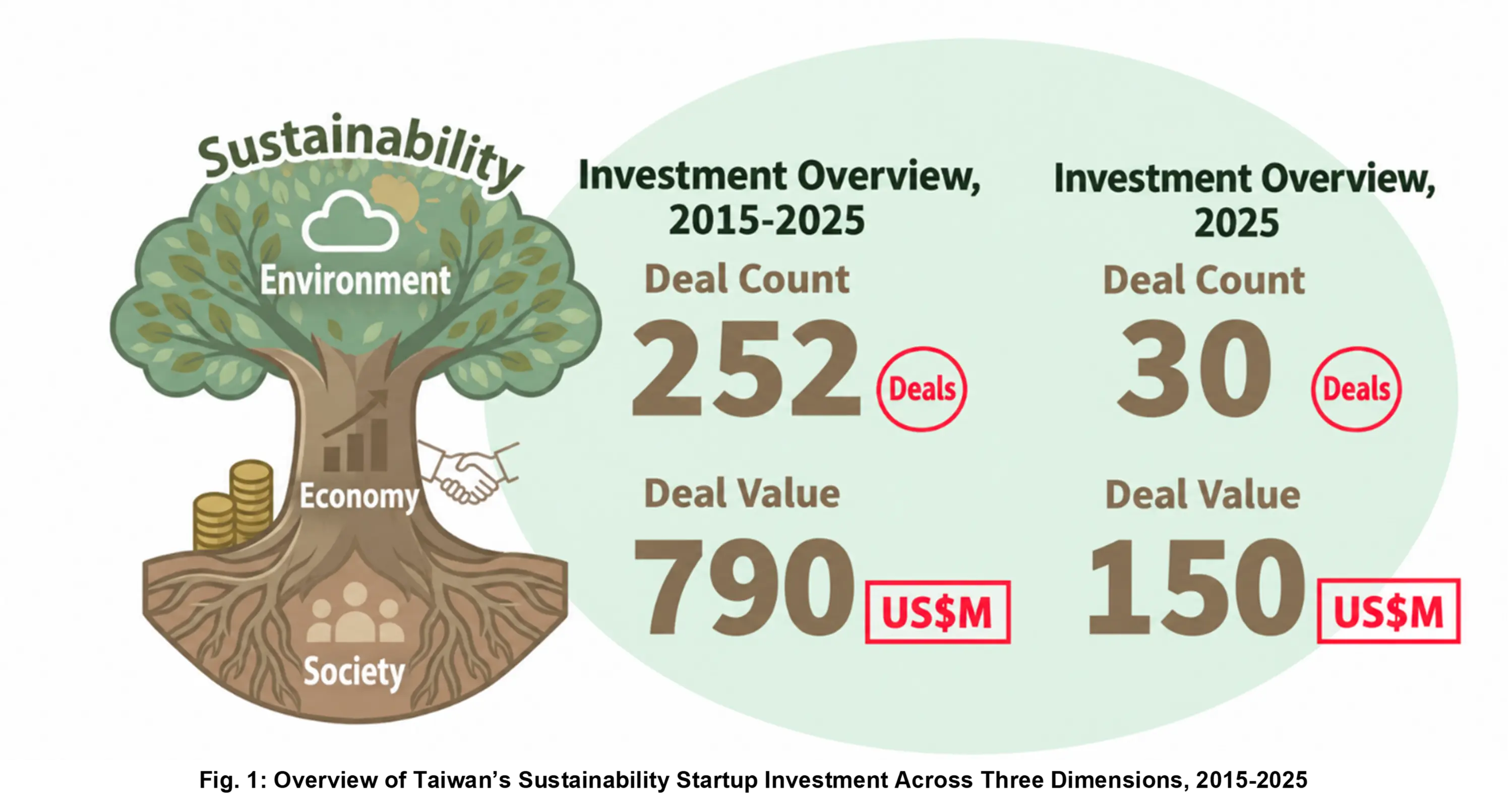 Based on an analysis of investment data from 2015 to 2025, the FINDIT Research Team categorized sustainability into three dimensions: economy, society, and environment. During this period, Taiwan's sustainability startups recorded 252 investment deals totaling approximately US$790 million. In 2025, investment declined significantly from 2024 levels to 30 deals worth US$150 million, while investors increasingly prioritized technological maturity, business models, and measurable carbon reduction outcomes.
Investment was concentrated in the early stages, with Series A and earlier rounds accounting for 79% of total investment value and 80% of deal count. The environmental dimension attracted the largest share of funding, with 163 deals totaling US$607 million. Waste recycling and treatment, along with eco-friendly and sustainable materials, attracted the most investor interest. Within the economic dimension, the sharing economy stood out.
Overview of Taiwan’s Green Energy Startup Investment
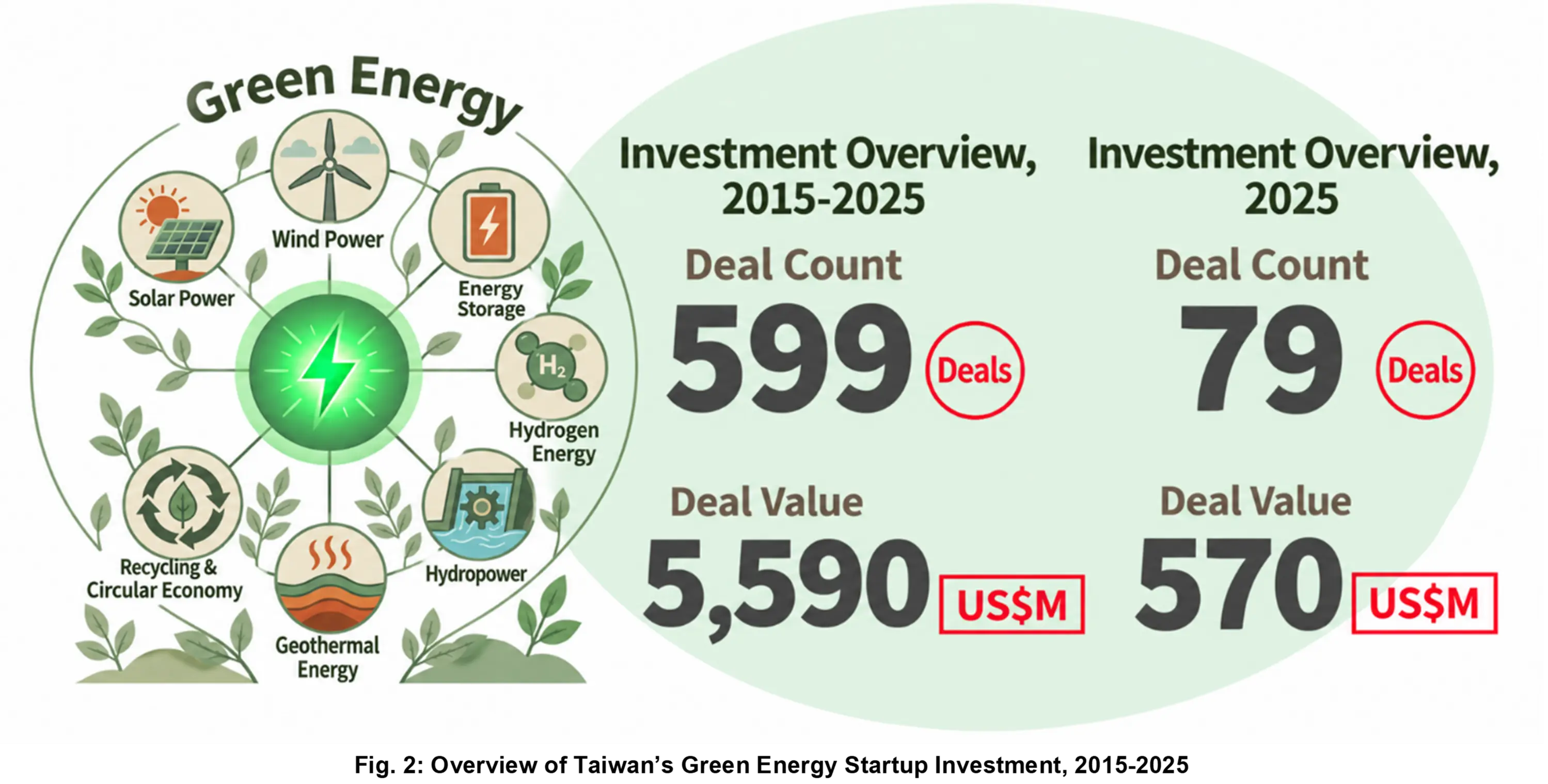 Between 2015 and 2025, Taiwan's green energy startups recorded 599 investment deals totaling US$5.59 billion, accounting for 11.78% of total early-stage investment deals and 25.85% of total investment value. In 2025 alone, the sector attracted approximately US$570 million across 79 deals.
Solar power and energy storage dominated investment activity, together accounting for approximately 85% of total green energy investment value and 88% of deal count. Wind power, meanwhile, is capital-intensive and involves larger individual deal sizes. Hydrogen and geothermal energy remain relatively small segments but offer growth potential.
Investment activity cooled in 2025 amid a period of adjustment in the global venture capital market, policy uncertainty, and challenges related to domestic project development and the regulatory environment. As carbon fees, sustainability disclosure requirements, and supply chain decarbonization measures take effect, businesses are increasingly prioritizing data security, system integration, and tangible operational benefits. Investors are also placing greater emphasis on startups' technological maturity, revenue, customer base, and potential to scale.
Investor Composition
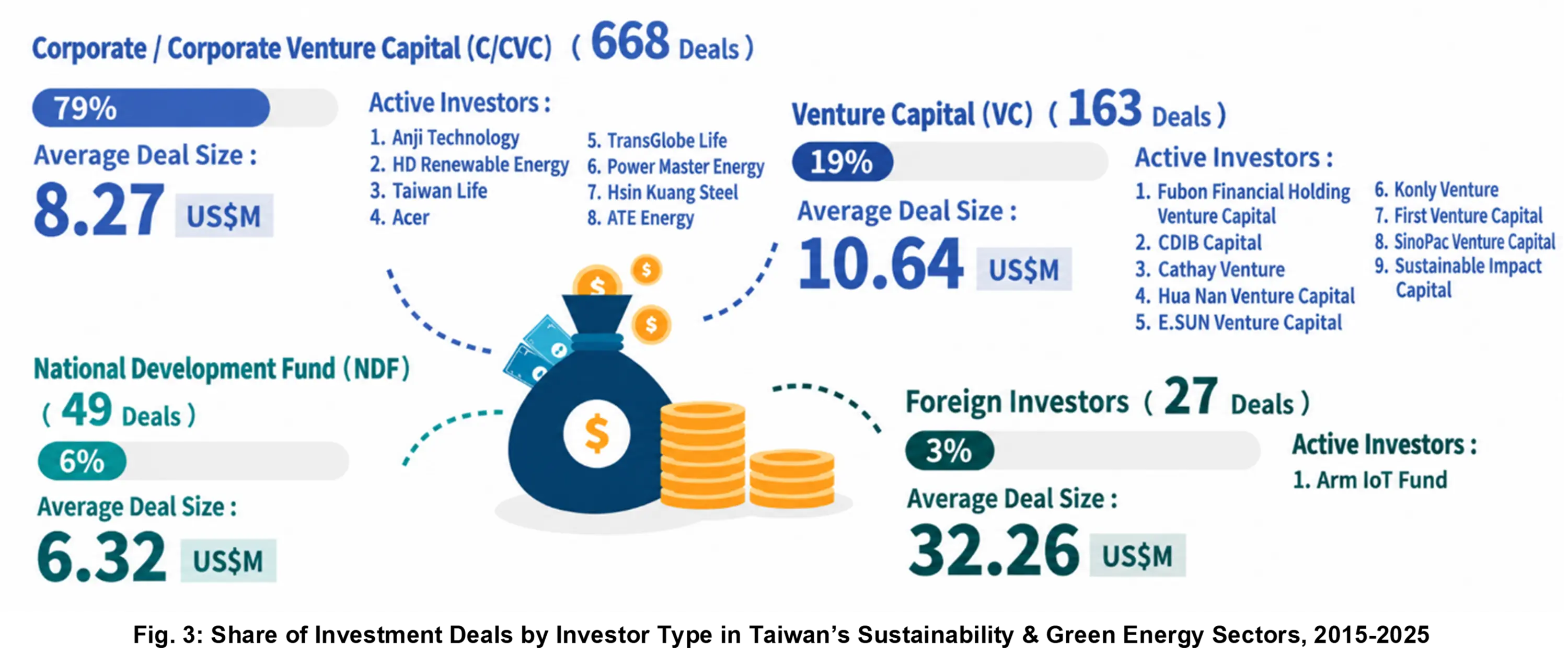 C/CVCs were the primary source of funding in the sustainability sector, participating in 668 investment deals, accounting for approximately 79% of total investor participation. VCs were involved in 163 deals, representing approximately 19%. The National Development Fund (NDF) participated in 49 deals, helping mobilize private capital through policy-driven investment. Although foreign investors were involved in just 27 deals, they had the highest average investment amount among all investor types, at US$32.26 million.
Overall, C/CVCs are playing an increasingly important role in the energy sector and across industry value chains, while VCs continue to support technology commercialization and business growth.
Outlook for Taiwan’s Sustainability & Green Energy Sectors
Looking ahead, Taiwan's sustainability and green energy startups retain growth potential. The Taiwan Green Growth Fund aims to mobilize private capital for net-zero and sustainability industries through government funding and venture capital mechanisms. Driven by carbon fees, the Carbon Border Adjustment Mechanism (CBAM), anti-greenwashing measures, and supply chain decarbonization requirements, markets for carbon management, carbon capture, utilization, and storage (CCUS), the circular economy, low-carbon manufacturing, and energy management are expected to continue expanding. Opportunities are also emerging in water resources, climate adaptation, and natural carbon sinks.
Meanwhile, the green energy market is expected to shift its focus from expanding power generation capacity toward integrated applications involving energy storage, smart grids, virtual power plants, and energy management. Overall, investors will place greater emphasis on technological feasibility, business models, environmental impact, and the potential to scale.

Ask a question and get an answer instantly; AI accompanies you on your exploration.
- What is the current state of global climate tech investment?
- How has Taiwan's sustainability startup investment performed from 2015-2025?
- Which dimensions of sustainability attracted the most investment in Taiwan?
- What is the investment landscape for Taiwan's green energy startups?
- What factors contributed to the slowdown in Taiwan's green energy investment in 2025?
- Who are the main investor types in Taiwan's sustainability and green energy sectors?
- What key criteria will investors prioritize in the future for these sectors?