【Taiwan Startup Investment Trends Annual Report – Hardware】From Prototypes to Production, Taiwan’s Hardware Startups Prove Their Strength
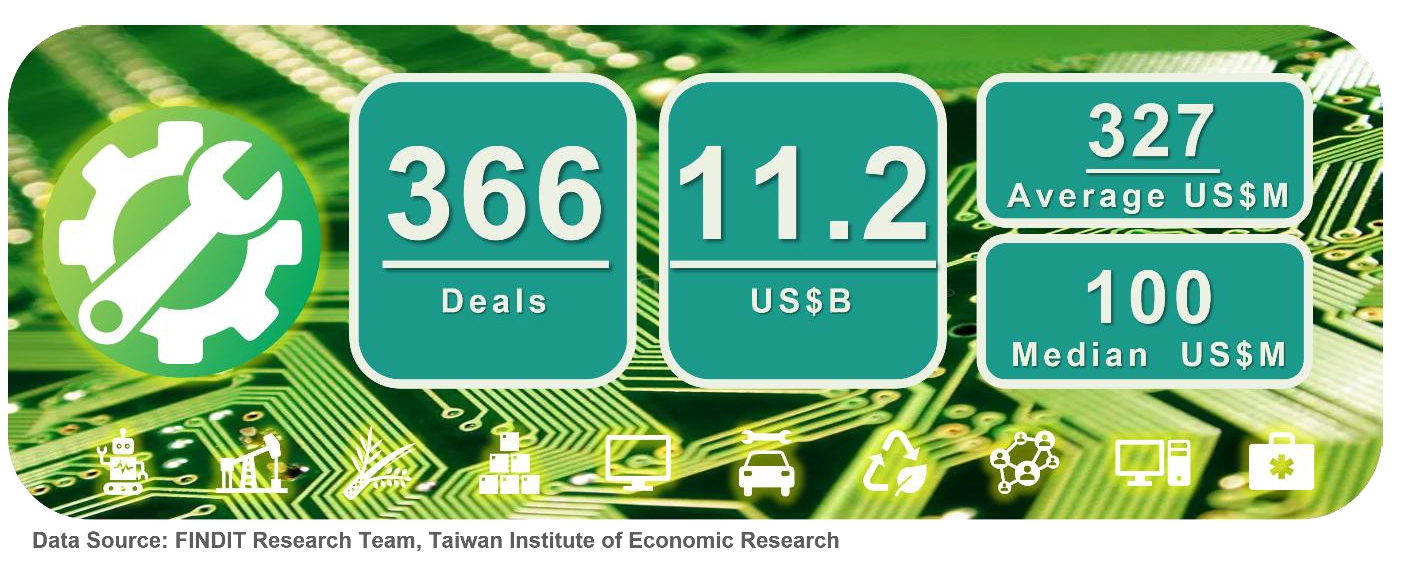
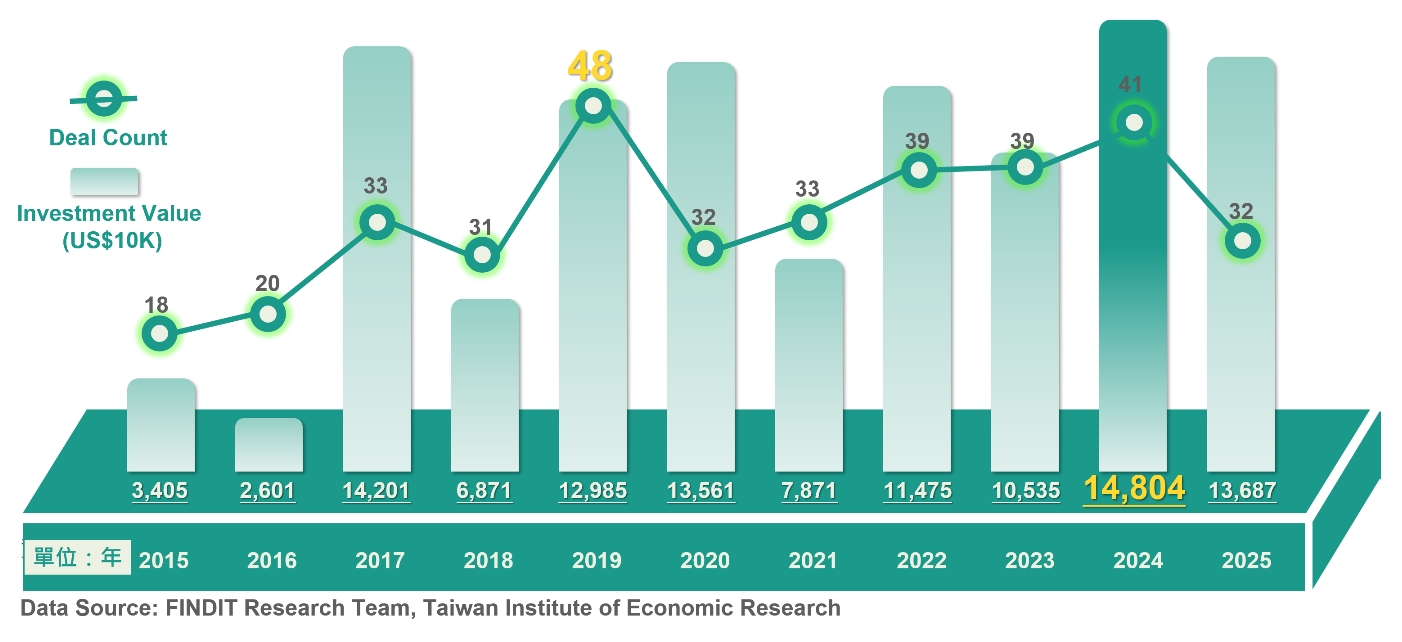
Driven by physical AI and edge computing, global venture capital is reviving interest in hardware, shifting toward integrated software-hardware solutions. Taiwan is leveraging its strong manufacturing foundation to transition from an OEM/ODM hub into a global co-development partner. According to FINDIT data from 2015 to 2025, Taiwan recorded 366 hardware startup deals totaling $1.12 billion, peaking in 2024. Investments are heavily concentrated in early stages, with 90% in Pre-A/Series A rounds and 84% under $7 million. Over 58% occur in Northern Taiwan, led by Optoelectronic Displays and Industrial Automation. Taiwan must now bridge early funding gaps and foster enterprise synergies.
1. Global Trends: AI-Driven Hardware-Software Integration
Global venture capital investment is shifting from a focus on software and foundation models toward integrated hardware-software solutions that bring AI into real-world applications. In 2025, global VC investment rebounded to US$469.3 billion, with AI accounting for US$225.8 billion, or 48.12% of the total. Funding for robotics startups also reached a record US$40.7 billion. Investment is increasingly focused on industrial and defense robotics, AI chips, data centers, memory, optical communications, power management, liquid cooling, sensors, and high-reliability manufacturing.
Of the world's 1,853 unicorns, 301 (approximately 16%) are hardware companies. This indicates that despite the challenges associated with R&D, mass production, and supply chain management, hardware startups with strong technological advantages and the ability to scale can still command high valuations. Leveraging its longstanding strengths in semiconductors, electronic components, precision manufacturing, and flexible manufacturing capabilities, Taiwan has an opportunity to move beyond its traditional ODM/OEM role and become a partner in product development and commercialization for international startups.
2. Investment Analysis of Taiwan's Hardware Startups
2.1 Overall Investment Trends
Between 2015 and 2025, Taiwan's hardware startups recorded a total of 366 investment deals, accounting for approximately 7.2% of all startup investment deals. Disclosed investment value reached US$1.12 billion, representing 5.2% of the total. Deal count peaked in 2019, while investment value reached a record high in 2024. Annual investment exceeded US$100 million in 2017, 2019, 2020, and each year from 2022 to 2025.
Investment activity has been driven by IoT, Industry 4.0, pandemic-driven digitalization, supply chain restructuring, and growing demand for generative AI, edge AI, and high-performance computing. However, the sector also remains sensitive to economic conditions, tariffs, and mass production costs.
2.2 Investment Stages, Geographic Distribution, and Subsector Performance
Investment in Taiwan's hardware startups is heavily concentrated in the early stages, with Series A and earlier rounds accounting for 90% of total deal count and 68% of investment value. Mid-stage investments represent 8% of deal count and 23% of investment value, while late-stage investments account for just 1% and 4%, respectively. Approximately 40% of deals were valued at under US$1 million, while 84% were below US$7 million. Only 3% exceeded US$15 million, highlighting a significant funding gap as startups transition from validation to scaling.
Geographically, Taipei, New Taipei, and Taoyuan collectively account for 58.5% of investment deals, while Hsinchu City and County recorded a combined 67 deals, reflecting the concentration of investment in northern Taiwan and the Hsinchu Science Park cluster. By subsector, optoelectronic displays and smart devices lead with 26% of deal count and 32% of investment value, followed by industrial equipment and precision manufacturing at 17% and 13%, respectively. Industrial automation and robotics account for 14% of both deal count and investment value, while energy, environment, and safety also represent 14% of investment value. Overall, investors show a clear preference for subsectors with established supply chains, high technological barriers to entry, and strong connections to international markets.
2.3 Key Investor Profiles
C/CVC are the primary sources of investment in Taiwan's hardware sector, with participation in 257 deals (70% of total deal count) and a combined investment value of US$930 million (83% of the total). Their investments primarily target optoelectronic displays, precision manufacturing, and robotics, driven largely by supply chain strategies and corporate transformation objectives.
VC firms participated in 89 deals (24%), representing US$440 million in investment value. Foreign investors participated in just 27 deals (7%), but the average deal size reached US$7 million, with a preference for startups that have completed validation and demonstrated the potential for international expansion. The National Development Fund (NDF) primarily makes smaller investments alongside co-investment arrangements and government endorsement to help attract additional private capital.
Overall, these patterns suggest that hardware investment goes beyond funding. Investors place particular emphasis on access to real-world testing environments, mass production capabilities, distribution channels, and industry resources.
3. Conclusion
AI is expanding beyond cloud-based applications into physical environments, including factories, transportation systems, healthcare facilities, and data centers, making hardware a critical link between AI algorithms and practical applications. By integrating its strengths in semiconductors, precision manufacturing, and electronics supply chains with startup innovation, Taiwan has the potential to evolve from a contract manufacturing hub into a global hardware innovation platform.
Corporations should involve startups in proof-of-concept validation, yield improvement, mass production, and international distribution, while leveraging investments, strategic partnerships, and acquisitions to expand market reach. The government, meanwhile, should establish pilot production and certification facilities for physical AI, industrial hardware, and medical devices, address growth-stage funding gaps, and facilitate domestic and international co-investment. Ultimately, competitive advantage will lie with teams that understand industry-specific applications, integrate AI software, master mass production processes, and build ongoing services around hardware products.