Taiwan Startup Investment Trends Annual Report – C/CVC Unpacking Taiwan’s C/CVC Investment Dynamics
This analysis of Taiwan's C/CVC investment landscape from 2015-2025 reveals significant generational shifts, with newer C/CVC investors engaging with startups much earlier. While overall startup survival rates are high (92.3%), a substantial portion (48.1%) face stagnation without further funding, termed 'zombie startups.' The study highlights that mid-sized companies are the primary drivers of investment, with a strong tendency towards independent investments rather than co-investment, except in capital-intensive sectors. Leading long-term investors often have clear ecosystem strategies, either from life insurers focusing on stable returns or manufacturers integrating new technologies. Recommendations include startups diversifying funding and investors investing earlier and expanding co-investment networks.
 This article draws on business registration data from the Ministry of Economic Affairs' Administration of Commerce and FINDIT platform data for the period 2015-2025. The dataset covers 2,985 investment deals, 1,798 funded startups, and 1,113 active C/CVC investors. The analysis examines Taiwan's C/CVC investment behavior, capital leverage dynamics, and the survival and growth prospects of funded startups.
1. Generational Shifts and a Sharp Reduction in Time to First Investment
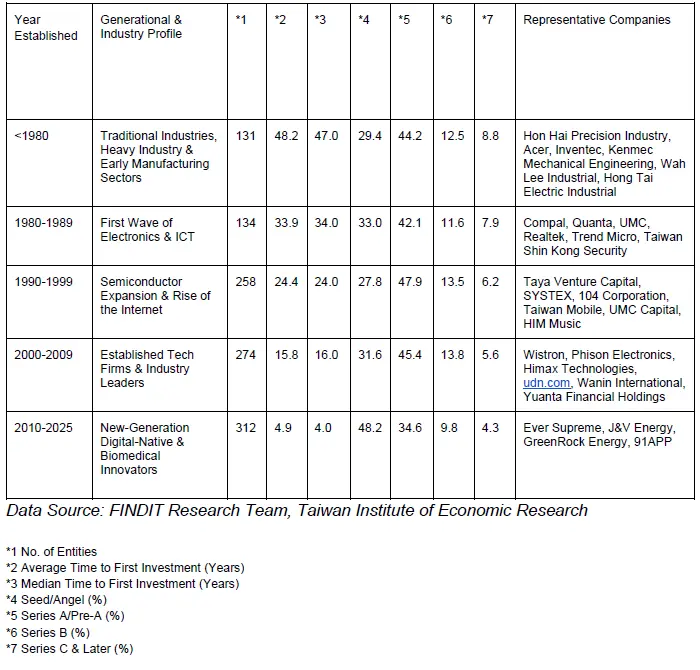
The study groups the 1,113 C/CVC investors into five generations based on their year of establishment. The findings show that the time from company establishment to the first investment in an external startup has shortened significantly with each new generation:
Tab. 1: Time to First Investment, Funding Round Preferences, and Representative Companies Across Five Generations of C/CVC in Taiwan
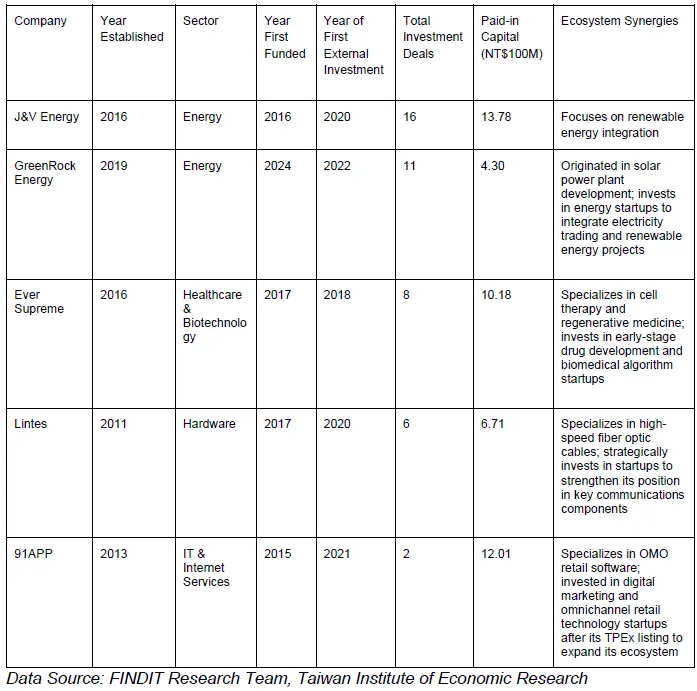
The study also identified 81 previously funded startups that have since become C/CVC investors, supporting the next generation of startups. Examples include J&V Energy, GreenRock Energy, Ever Supreme, and 91APP. This transition reflects a Silicon Valley-style cycle of reinvestment and founder-led support for the startup ecosystem.
Tab. 2: Representative Cases of Former Startups Becoming C/CVC Investors
2. Follow-on Investment Patterns: The 80/20 Rule and Leading Long-Term Investors
Questions remain about C/CVC investors' long-term commitment. An analysis of their investment histories reveals the following:
●80/20 Follow-on Investment Rule: In 80.2% of investment deals, C/CVC investors participated in only one funding round, typically reflecting exploratory investments or partnerships tied to specific business needs. Only 19.8% participated in two or more rounds, while just 2.1% invested across four or more rounds, a proportion comparable to that seen among CVC investors globally.
●Leading Long-Term Investors: Investors with clear ecosystem strategies demonstrate particularly high follow-on investment rates and fall into two main categories:
●Life Insurers with Long-Term Capital: Companies such as Taiwan Life (70.0%) and Fubon Life (60.0%) favor investments that generate stable cash flows or involve public infrastructure projects.
●Manufacturing and Hardware Leaders: Companies such as Darwin Precisions (66.7%), Ta Ya Electric Wire & Cable (66.7%), and Acer (50.0%) integrate startup technologies into their corporate operations through strategic partnerships and vertical integration.
3. Capital Leverage Ratios and Co-investment Patterns
●Mid-sized Companies as Key Investors: Capital leverage ratios, defined in this study as investor capital divided by startup capital, fall predominantly within the 1.0x–5.0x (27.8%) and 5.0x–20.0x (25.5%) ranges, together accounting for 53.3% of deals. This suggests that Taiwan's C/CVC investment landscape is driven primarily by established mid-sized companies with capital ranging from several hundred million to several billion NT dollars, rather than large multinational corporations with capital in the hundreds of billions.
●Significant Differences in Capital Leverage Across Sectors: The AI & data analytics sector has a median leverage ratio of 13.8x and an average of 158.6x, often reflecting an outsourced R&D model. In contrast, sustainability (3.0x), energy (4.1x), and manufacturing (4.3x) are characterized by more balanced partnerships between investors and startups of comparable capital size.
●Limited Co-investment and a Clear Divide in Investment Strategies: C/CVC investors participate independently in 76.7% of deals, while co-investment accounts for only 23.3%. In capital-intensive sectors with long supply chains, such as energy (34.0%) and transportation & logistics (31.3%), investors are more inclined to pool capital through co-investment. By contrast, independent investment predominates in hardware (19.9%), fintech (20.5%), and AI (21.4%), where investors prioritize technology exclusivity and first-mover advantages.
4. Funded Startup Survival Rates and Warning Signs of “Zombie Startups”
●High Overall Survival Rate: Among startups backed by C/CVC investors, 92.3% remain operational, compared with an overall survival rate of 85% among Taiwanese startups. This suggests that C/CVC support through procurement contracts, testing and validation opportunities, and corporate credibility provides an additional layer of protection beyond financial investment.
●Risk of Stagnation (“Zombie Startups”): Remaining operational does not necessarily mean a startup is continuing to grow. Among active startups, 48.1% have not secured additional funding for more than four years, while 39.4% have received no new investment for more than five years. Financial services (69.0%) and digital content (65.1%) have the highest shares of startups without new funding for over four years, potentially reflecting domestic market constraints or challenges in international expansion. By contrast, energy has the lowest share (31.0%), supported by favorable policies and strong demand for renewable energy.
5. Strategic Recommendations for Ecosystem Participants
5.1 For Startups
●Distinguish Long-Term Partners from One-Time Investors: When C/CVC involvement is limited to a single funding round, startups should plan ahead to secure independent funding for their next round.
●Manage Risks Arising from Capital Disparities: When the investor-to-startup capital ratio exceeds 100x, startups should carefully assess the risks of losing control, rights of first refusal (ROFR), and exclusivity clauses. When partnering with mid-sized corporate investors with capital ratios of 1x–5x, they should prioritize jointly developing distribution channels and production capacity.
●Avoid Reliance on a Single Corporate Customer: Relying too heavily on orders from a single corporate customer can gradually weaken a startup's pricing power.
●Diversify the Investor Base and Build Co-investment Networks: Startups should build a diversified investor base and develop co-investment networks involving investors that do not compete with one another.
5.2 For C/CVC Investors
●Begin Investing in External Startups Earlier: Identify and evaluate external technologies during the company's growth stage.
●Expand Co-investment Networks in Capital-intensive Sectors: Build partnerships between lead investors and follow-on investors to share investment risks.
●Establish Clear Exit Mechanisms for Mature Portfolio Startups: For startups that have reached a stable operating stage after more than four years of investment, develop internal M&A or equity transfer mechanisms to free up capital and facilitate the reinvestment of resources into the startup ecosystem.